
How Did The Fiber Cement Felt Make ?
Fiber Cement Board Felt
The Function of Fiber Cement Felt
This felt is used for forming the fiber cement board , and also called forming felt. Whichever flow on machine or hatschek machine will both use the fiber cement felt to form the board.
-Dehydration molding of pulp;
-Run forward with the slab;
-Ensure that the board surface is flat, non stick to the felt, and not deformed.
The Structure of Fiber Cement Felt
1. Bottom Base Mesh (skeleton)
The weaving of nylon filament and nylon monofilament determines:tensile strength, non elongation, dimensional stability, and lifespan.
2. Middle Layer
Nylon staple fiber needled, determines: filtration speed, elasticity, and surface fineness.
3. Surface Layer
Smooth, wear-resistant, and non stick, it determines:is the quality of the board surface and demolding good.
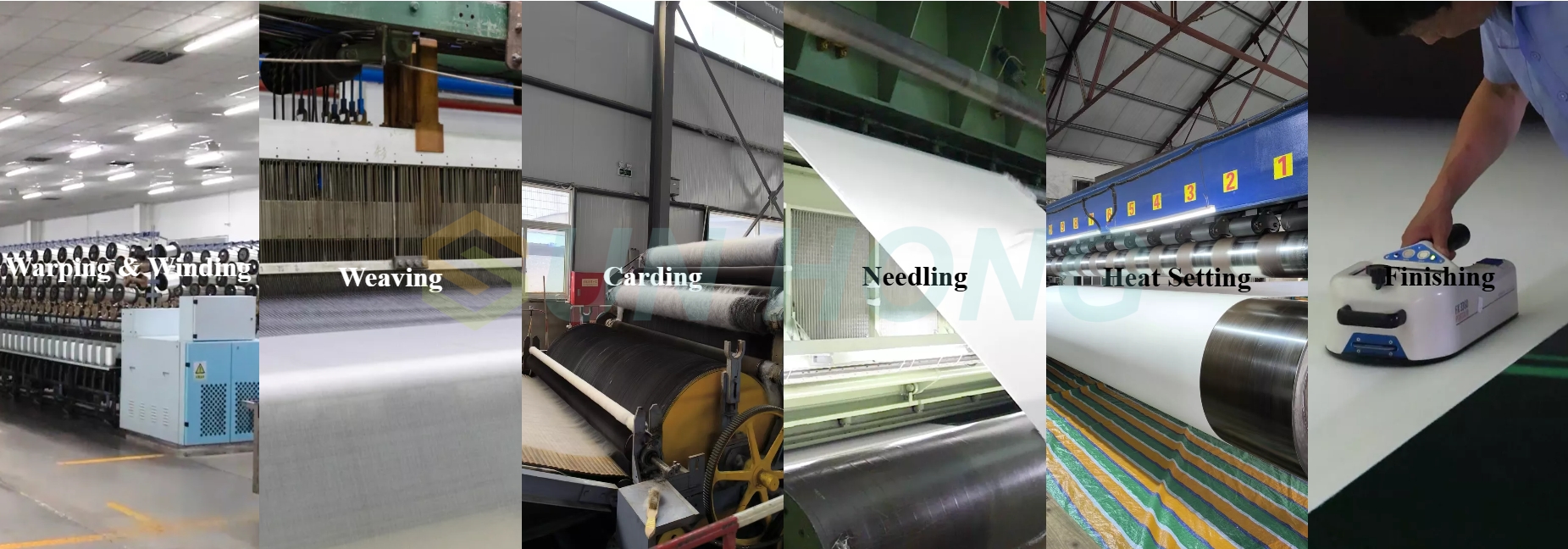
How to Choose Suitable Fiber Cement Felt ?
1. The thicker the longitude, the more strands there are
→ The stronger the tensile strength, the less elongated, and the more continuous the edge
2. The thicker the single thread of the weft
→ The better the stiffness, the faster the water filtration
3. Diagonal weave (2/2, 1/3)
→ 2/2 diagonal: fast water filtration
→ 1/3 diagonal: high strength, long service life
4. The higher the latitude and longitude density
→ The more stable the size, but the filtered water will decrease
5. The heat setting temperature is sufficient (180-210 ℃)
→ The felt does not stretch, deviate, or wrinkle
6. Post finishing (calendering, hydrolysis resistance)
→ The board surface is cleaner, alkali resistant, and has a longer lifespan
|
|
|


Technical Sheet for Fiber Cement Felt
| Material | Nylon (PA), must be resistant to hydrolysis and alkali |
| Weight | 800-1200 g/m ² |
Thickness | 1.8-3.0 mm |
| Breathability | Moderate (determines the speed of water filtration) |
| Tensile strength | The higher the longitudinal strength, the better |
| Elongation | ≤ 2% (the lower, the less elongated) |
| Surface | Smooth, no knots, no burrs |
| Width | Customized according to equipment (1.6m – 6.8m) |
Felt Belt for Paper, Fiber Cement, and Textile Industry


